Predictive Validation Framework for Certification Support
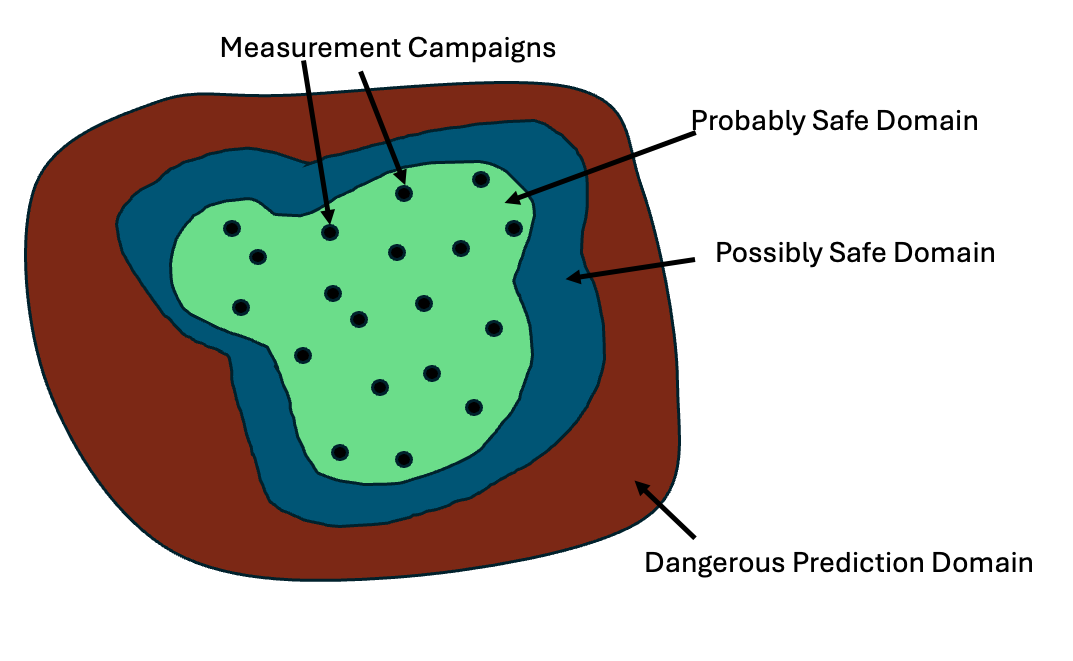
Framework for model validation under uncertainty with predictive capability
Overview
This research presents a comprehensive framework for validating computational models under uncertainty, with a specific focus on reducing the number of expensive prototype measurement campaigns required for certification. The work is presented across two papers that together provide both the theoretical foundation and practical implementation.
Core Methodology
1. Validation Under Uncertainty (Published)
The first paper establishes a rigorous framework that separates two types of uncertainty:
- Aleatoric uncertainty: Natural variability that cannot be reduced (e.g., weather patterns over time)
- Epistemic uncertainty: Knowledge-based uncertainty that can be reduced through better measurements or models
This separation enables quantification of model validity that accounts for both measurement imperfections and natural variability. The framework includes rigorous tests that validation metrics must satisfy, ensuring that improved measurements and longer campaigns are properly rewarded.
2. Model-Validity Predictor (Preprint)
The second paper extends this framework with a predictive capability called the Model-Validity Predictor (MVP). Key innovations include:
- Predicting validation results for untested designs based on previous campaigns
- Quantitative definition of "probably safe" and "possibly safe" domains
- Integration of Bayesian calibration to separate parameter from model-form uncertainty
- Strategic planning tool for determining where new campaigns add most value
Key Results
72% Expansion of Safe Domain
By selecting physically meaningful design variables (hub height and specific power) instead of traditional parameters (rated power and diameter), the predicted safe domain expanded by 72%. This demonstrates the framework's ability to quantify and expand model trust regions.
Reduced Campaign Requirements
The MVP framework enables certification of turbine variants without new measurement campaigns when predictions indicate sufficient model validity, potentially saving months of testing time and significant costs.
Applications
While demonstrated on wind turbine power curves, this framework is applicable to any certification process requiring model validation:
- Wind turbine loads and performance certification
- Automotive safety systems validation
- Aerospace component certification
- Any safety-critical system requiring model validation
Technical Contributions
- Rigorous separation of aleatoric and epistemic uncertainties
- Validation metrics that pass mathematical consistency tests
- Quantile-based Gaussian Process regression for conservative predictions
- Relative-ABC Bayesian calibration integrated with validation
- Leave-one-out cross-validation for MVP hyperparameter tuning
Industry Impact
This work directly informs the development of the IEC 61400-60 standard for wind energy model validation. The framework provides a quantitative, evidence-based approach to determining when models can be trusted without additional physical testing, supporting the transition to more efficient certification processes while maintaining safety standards.
Future Work
Future extensions include applying this framework to high-fidelity turbine loads models, wake models for wind farm control, and expanding to other safety-critical applications beyond wind energy. The framework also provides a foundation for k-fold cross-validation approaches that separate calibration and validation datasets.