ML-Based Wind Turbine Condition Monitoring
Normal behavior models with CUSUM anomaly detection for predictive bearing maintenance
57%
Fewer False Alarms
1,120 h
Detection Lead Time
Normal behavior models with CUSUM anomaly detection for predictive bearing maintenance
I supervised this MSc thesis by James Kanoksilp at DTU Wind & Energy Systems. Over four months of weekly meetings, I guided the research direction, helped frame the problem as an end-to-end detection pipeline (not just a prediction task), and advised on the systematic optimization methodology—particularly the CUSUM parameter grid search, the target-lag tradeoff analysis, and the bias correction strategy that ultimately produced the best result.
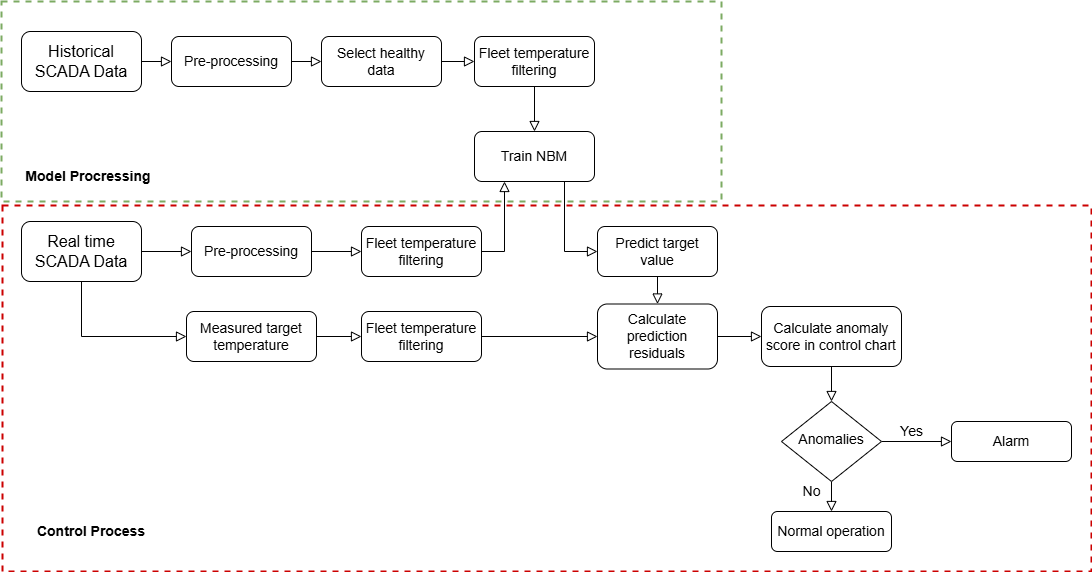
Wind turbine O&M costs account for 25-30% of offshore lifecycle costs. This project developed Normal Behavior Models (NBMs) that learn healthy operating patterns from SCADA data and flag deviations as potential bearing failures. The approach combines ML prediction (XGBoost and LSTM) with CUSUM anomaly detection, systematically optimizing the full pipeline from feature selection through alarm thresholds.
The study used open SCADA data from 5 wind turbines provided by EDP, covering 80 operational parameters at 10-minute intervals over 2 years. The pipeline was evaluated on generator and gearbox bearing failure detection, with the goal of minimizing false alarms while maintaining early detection within a 60-day pre-failure window.
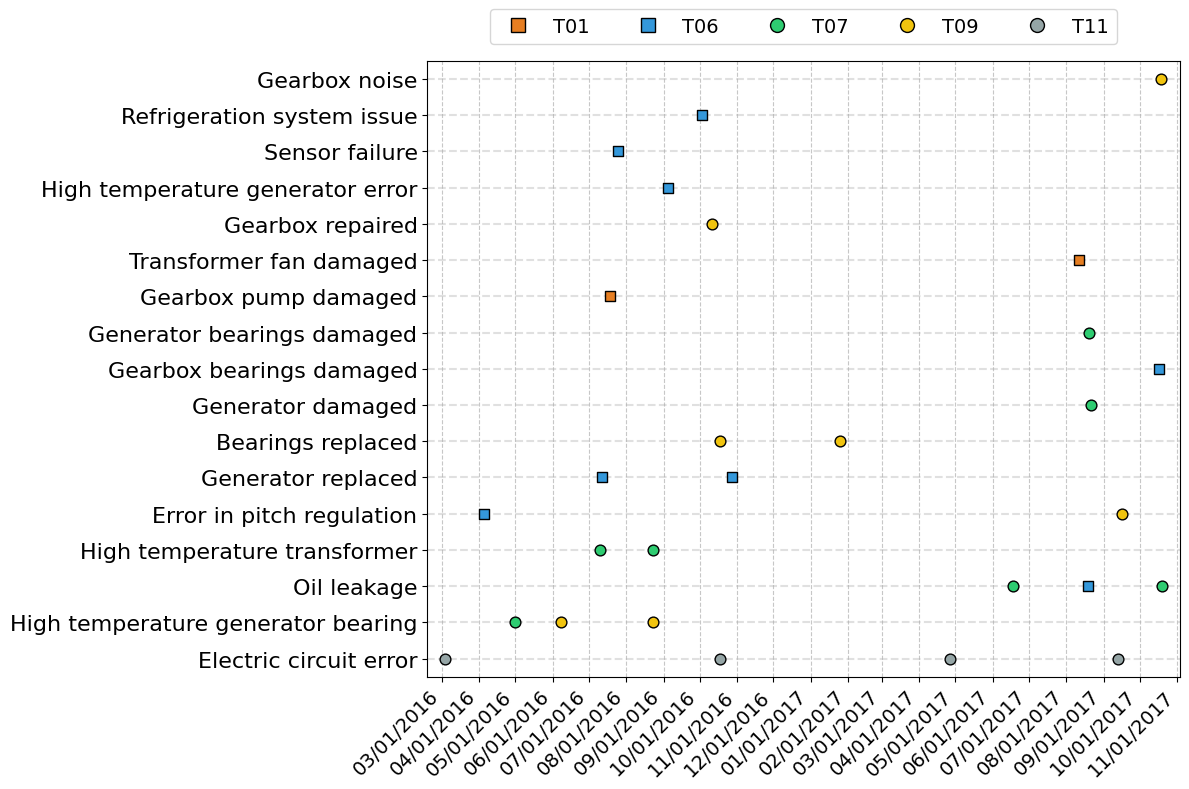
Annotated failure events across 5 turbines over the 2-year monitoring period. Generator bearing, gearbox bearing, and hydraulic system failures are the key detection targets.
Cross-validation revealed that XGBoost consistently outperformed LSTM by 10-15% on both RMSE and MAE for bearing temperature prediction. XGBoost achieved optimal performance with lag step 3 and 15-17 SHAP-ranked features, while LSTM showed stable but lower accuracy across configurations.
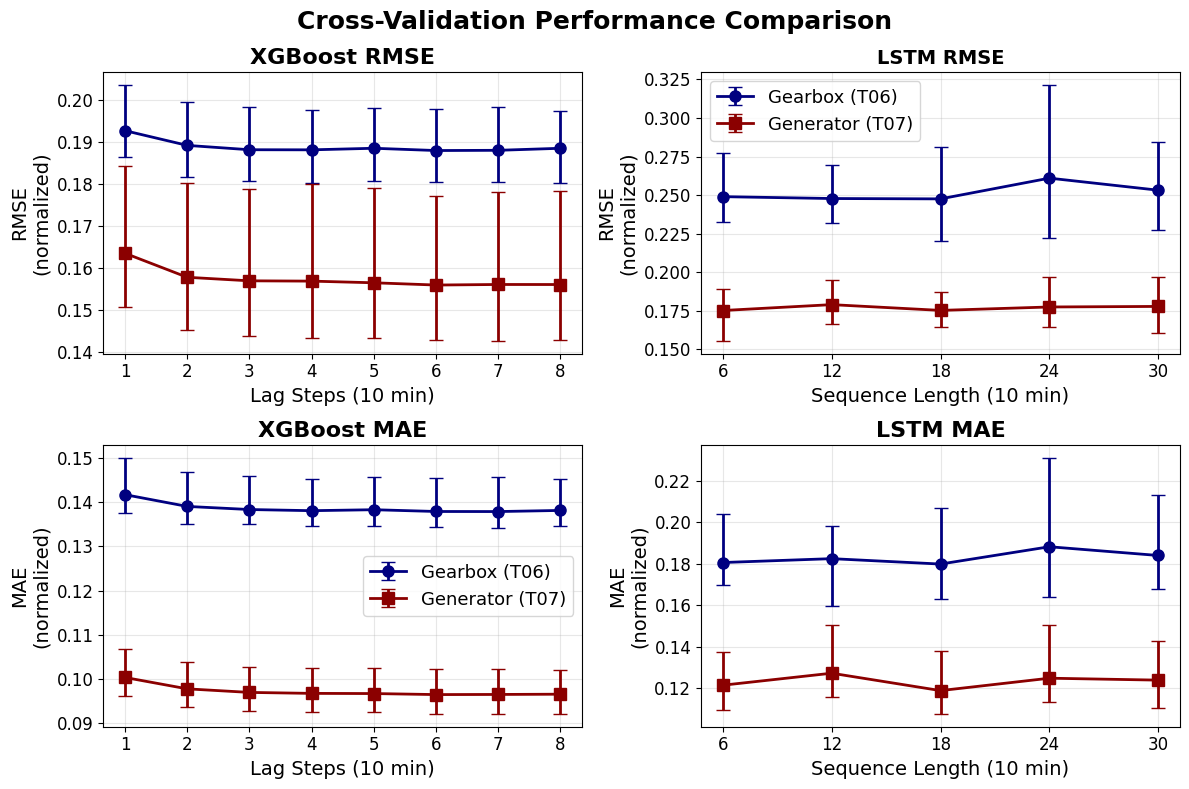
Cross-validation RMSE and MAE for XGBoost (varying lag steps) and LSTM (varying sequence lengths) on generator and gearbox bearing temperature prediction.
A critical insight: including lagged target features as inputs dramatically improves prediction accuracy (MAE drops ~80% for generator bearings) but can mask early degradation signals. When the model uses recent target history to predict the next value, it tracks degradation so closely that subtle pre-failure drift disappears from the residuals. Excluding lagged targets produces worse predictions but clearer anomaly signals—after bias correction.
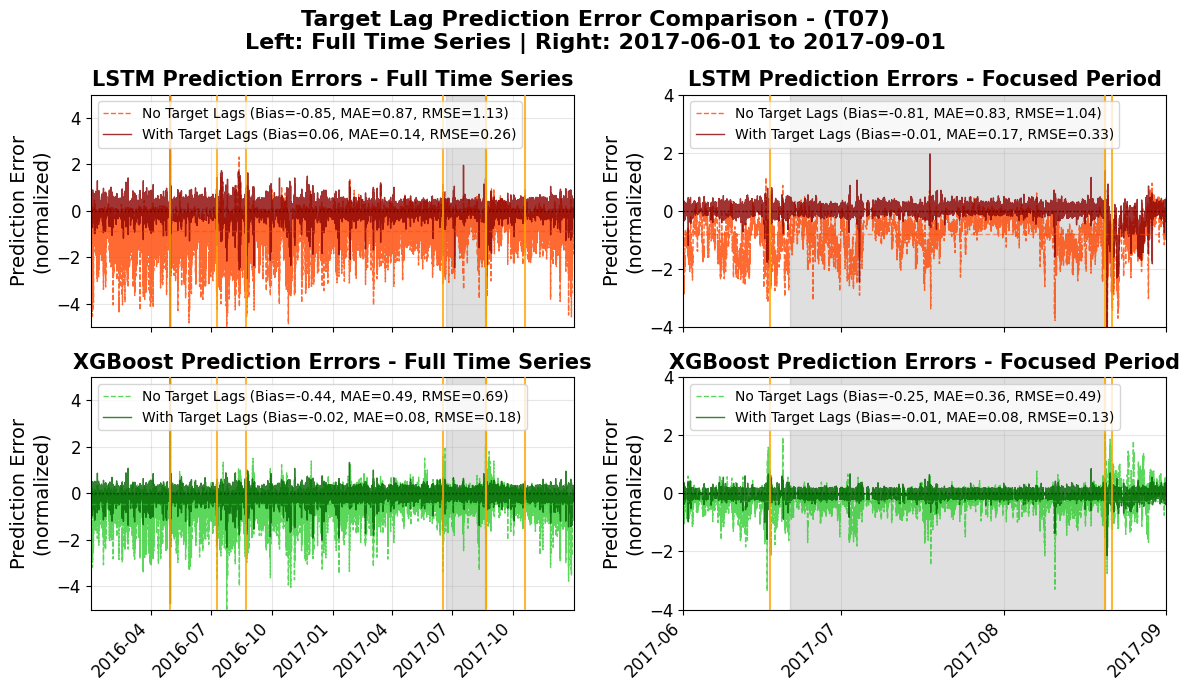
Generator bearing prediction comparison: with target lag (top, low error but masked degradation) vs without (bottom, higher error but visible pre-failure drift).
The Cumulative Sum (CUSUM) algorithm detects shifts in the mean of a process by accumulating prediction residuals. The upper and lower CUSUM scores are updated at each time step:
S+t = max(0, S+t-1 + (et - k))
S-t = min(0, S-t-1 + (et + k))
where et is the prediction residual, k is the sensitivity parameter, and an alarm is raised when |St| > h.
The sensitivity (k) and threshold (h) parameters were systematically optimized via grid search for each model-component combination. The optimization minimized false alarms subject to successful detection within the 60-day window. For generator bearing detection, CUSUM optimization reduced LSTM false alarms from 14 to 6—a 57% reduction—while maintaining a detection lead time of 1,120 hours. Component-specific requirements emerged: generator bearings benefit from higher sensitivity (k=1.5) to capture spike-based failures, while gearbox bearings need lower sensitivity (k=0.2) for gradual degradation accumulation.
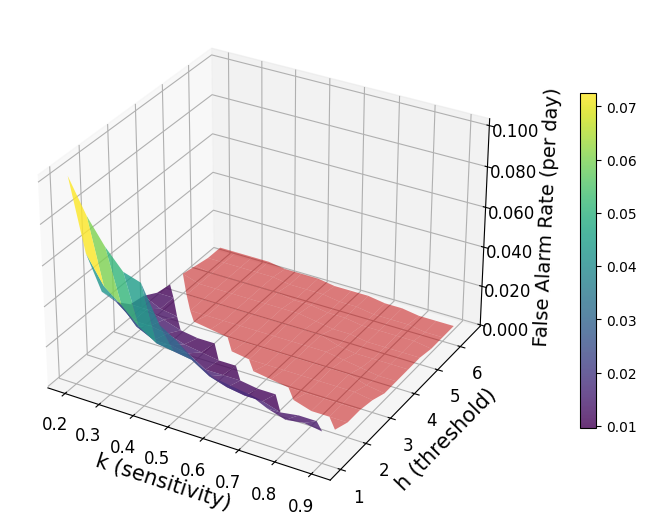
Grid search over CUSUM k and h for XGBoost generator bearing detection. Red regions fail to detect within 60 days; color intensity shows false alarm count for successful configurations.
The best configuration combined XGBoost on raw (unfiltered) temperature data with a 100-day rolling mean bias correction. This achieved generator bearing failure detection with only 1 false alarm—and that single alarm corresponded to a real sensor replacement event. The CUSUM detected the failure through small but persistent prediction error drift, exactly the type of subtle signal the algorithm was designed for.
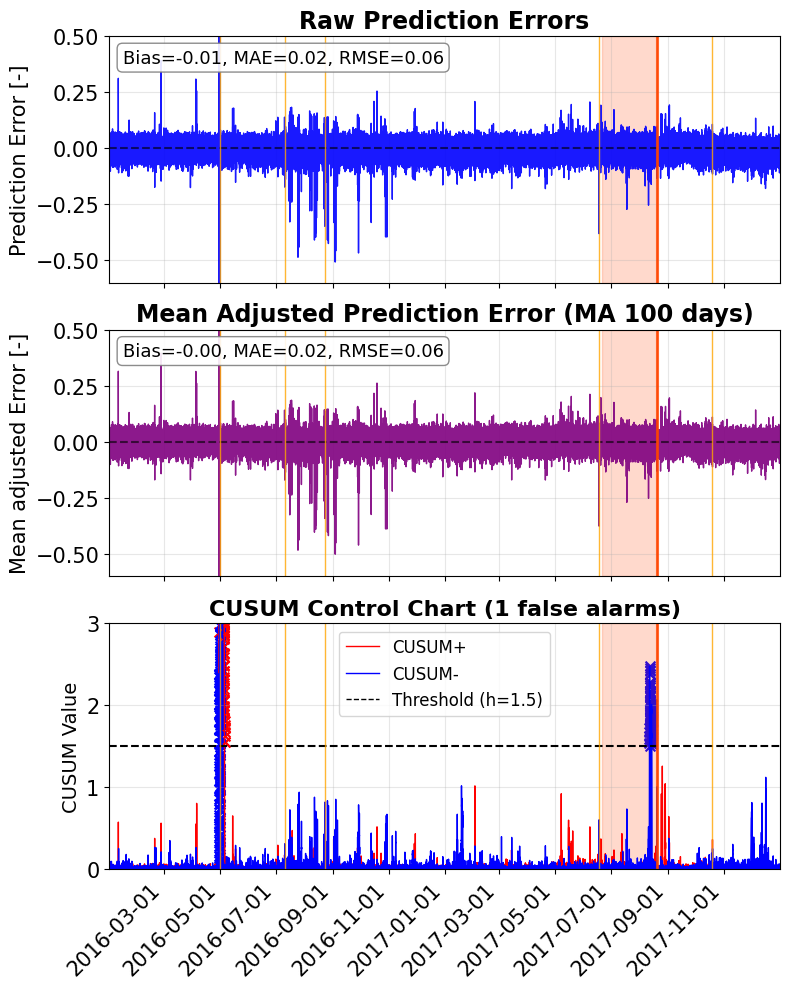
XGBoost generator bearing detection with 100-day rolling mean bias correction. CUSUM parameters k=0.03, h=1.5. Only 1 false alarm over the full test period.