Graph Neural Operators for Fluid Dynamics
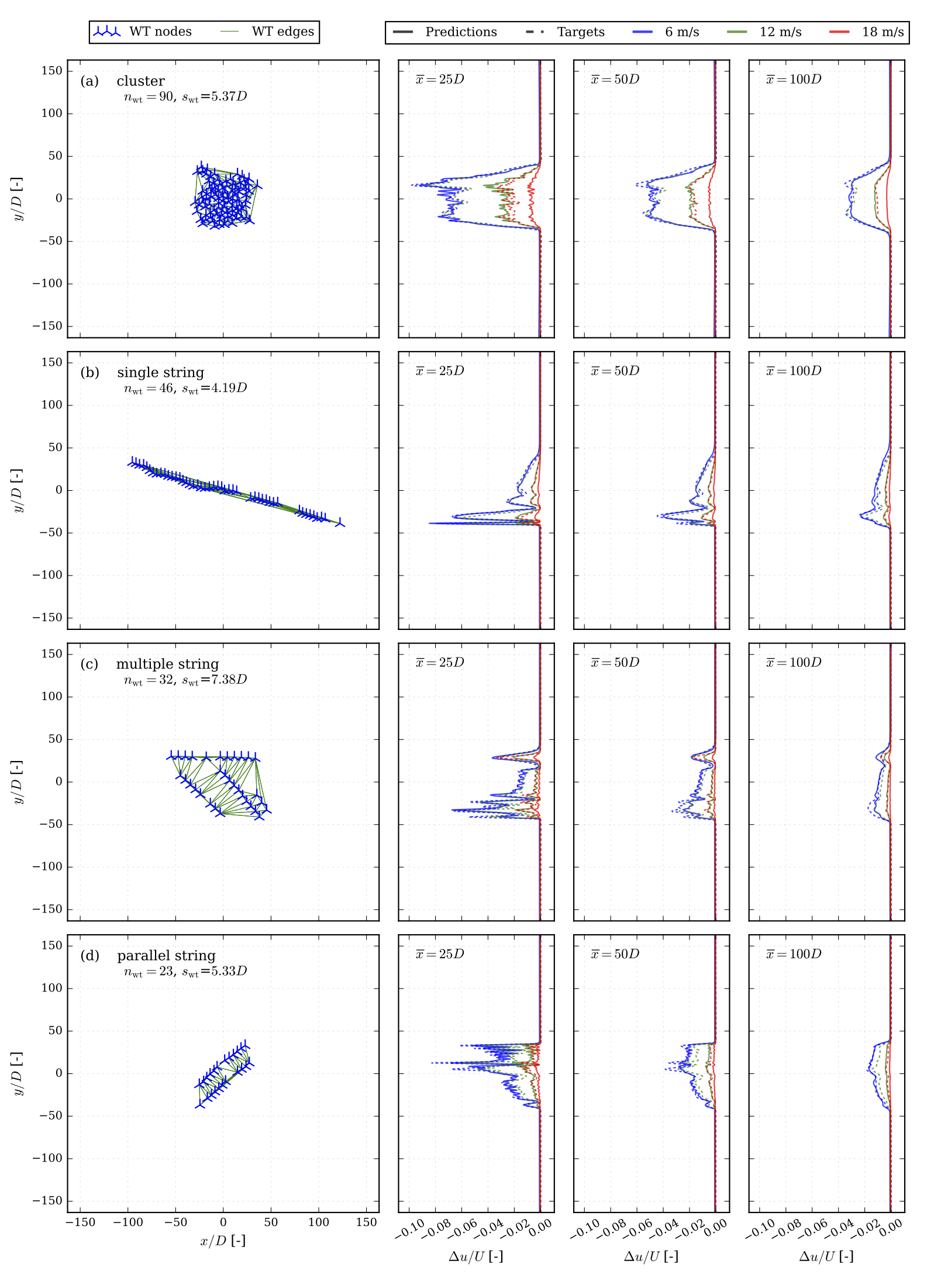
Figure 9: GNO predictions vs. Ground Truth for unseen wind farm topologies. The model generalizes zero-shot to new layouts.
Project Overview
Standard deep learning (CNNs) struggles with physical systems that have varying topologies, unstructured meshes, or changing boundary conditions. In this work, I supervised the development of a Graph Neural Operator (GNO) designed to act as a surrogate for computational fluid dynamics (CFD) in wind energy.
By embedding a learnable superposition principle into the graph message-passing architecture, we created a model that is discretization-independent. It does not just learn to predict pixels; it learns the underlying solution operator of the physics, allowing it to generalize zero-shot to entirely new farm layouts with varying numbers of turbines.
Architecture: Physics-Induced Graph Learning
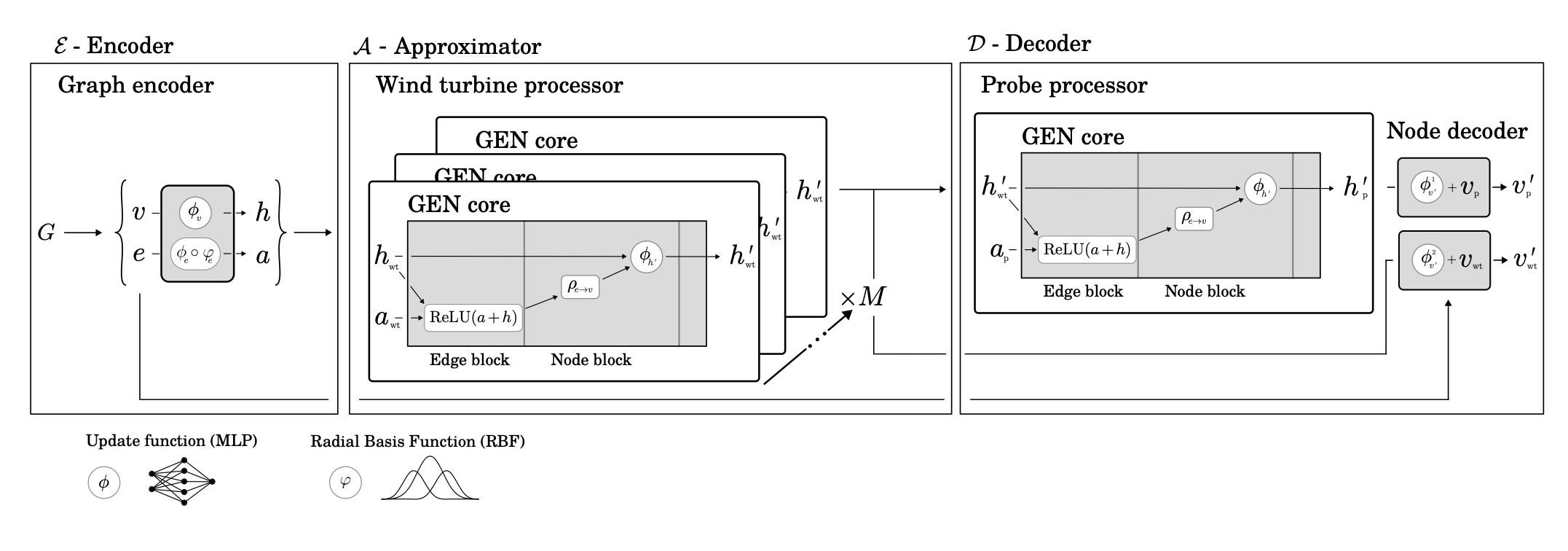
The Encoder-Processor-Decoder architecture inspired by the NOMAD framework.
The model utilizes a DeepGraphONet architecture within the NOMAD (Nonlinear Manifold Decoders) framework:
- Encoder: Maps turbine states and relative positions into a high-dimensional latent space using Radial Basis Functions (RBFs) to capture spatial decay.
- Approximator (Processor): A Generalized Aggregation Network (GEN) performs message passing to simulate the non-linear interaction of wakes between turbines.
- Decoder: Projects the latent turbine states onto arbitrary query points in the flow field, allowing for resolution-independent inference.
Impact & Results
- Accuracy: Achieved an RMSE of 0.353 m/s on unseen test data, accurately capturing complex wake merging and recovery.
- Speed: ~10x faster than engineering wake models (PyWake) and potentially 10,000x faster than RANS CFD.
- Generalization: Unlike CNNs, the GNO handles graphs of varying sizes (different numbers of turbines) without retraining, enabling real-time layout optimization.
Relevance to Scientific Machine Learning
This work demonstrates the potential of Operator Learning to replace expensive numerical solvers in engineering loops. It moves beyond "black box" surrogates by enforcing physical inductive biases (like superposition and spatial locality) directly into the neural architecture.